Project / Fall 2025

Fillmore Ecosystem

Year

Fall 2025

Type

Research · Market Analysis · Community

Skills

Community Research

Field Interviews

Market Analysis

SWOT

Public Policy

Data Analysis

What I Built

Community-based research into SF's Lower Fillmore food and pharmacy desert after the Safeway closure.

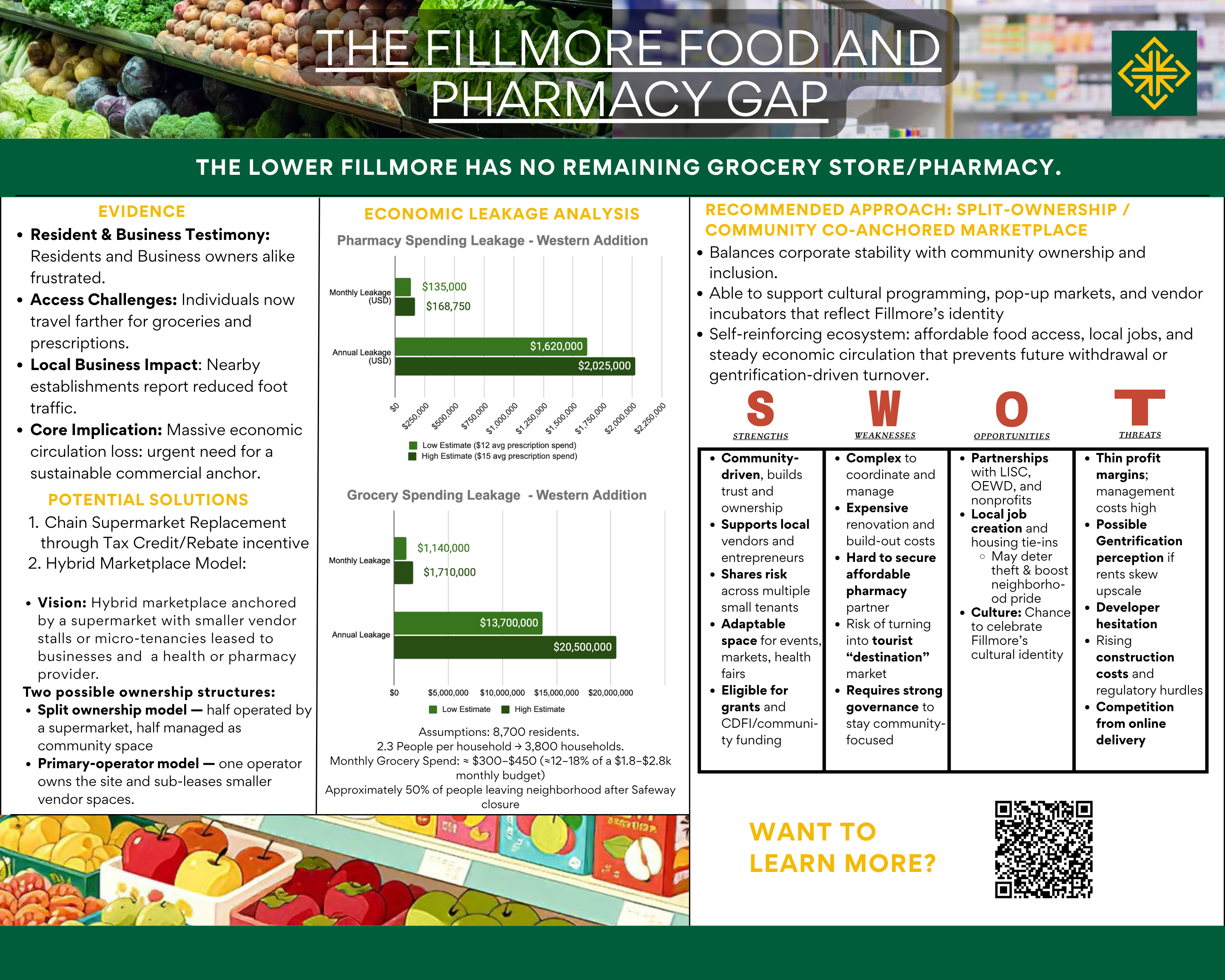
Spent a semester researching SF's Lower Fillmore after the Safeway closure created a food and pharmacy desert for ~8,700 residents. Estimated $8M+ in annual leakage and pitched a hybrid community marketplace to a panel of six SF decision-makers.

A move that created a food and pharmacy desert for ~8,700 residents, 17% of them seniors, with 50% of some tracts below SF's poverty line. We estimated $6.8M–$10.3M in annual grocery spend and $1.6M–$2.0M in pharmacy revenue leaking out of the neighborhood. Before ideating solutions, we walked the block, interviewed residents and local businesses (KC Paris Desserts, Sheba Jazz, Miyako's), studied the neighborhood's demographics, and researched its history as the former "Harlem of the West." We evaluated two redevelopment models via SWOT analysis and pitched our main recommendation — a hybrid Fillmore Community Marketplace — as a poster at YesSF and as a live presentation to a panel of 6 SF decision-making executives.

Our research poster presented at YesSF — the hybrid Fillmore Community Marketplace model.
Presenting at the YesSF open floor alongside my teammate Orlando.
Open floor Q&A at YesSF — fielding questions from attendees and decision-makers.
The team.
The panelists — 6 SF decision-makers evaluating our pitch.
01 / 05

Our research poster presented at YesSF — the hybrid Fillmore Community Marketplace model.

Our research poster presented at YesSF — the hybrid Fillmore Community Marketplace model.

Our research poster presented at YesSF — the hybrid Fillmore Community Marketplace model.

Our research poster presented at YesSF — the hybrid Fillmore Community Marketplace model.

01 / 05

Estimated Annual Leakage

$8.4M–$12.3M across groceries and pharmacy

Decision-Maker Audience

Presented live to 6 SF executives at YesSF

Seed Funding Raised:

$1,500

POST-PROJECT REFLECTION

What I Took Away

What I learned. Ranges anywhere from technical skills, to general lessons.

My goal is to always learn from an experience, no matter how big or small.

This project was a sobering lesson in the limitations of grassroots entrepreneurship and how business actually moves. I realized that community impact — the kind that's real and meaningful to residents — isn't naturally legible to the systems that make decisions about land use, development approvals, and commercial investment.

Through our SWOT analyses, we recognized that simply incentivizing another massive national chain to move into where the Safeway originally was wouldn't solve the root issues that pushed out the old tenant (like organized theft and low margins). Yet, pitching a community-owned model to city planners was incredibly difficult because those same community benefits aren't easily quantifiable in the strict language of commerce, capitalism, and tax incentives.

It doesn't mean community work is pointless — it means the work of translating community needs into business logic is real and hard, and most people skip it. Everything requires margins and feasibility checks. If you want community benefit to survive contact with that system, you have to root it in concrete facts, or be honest that your proposals will likely be sidelined by the top-down, multi-year luxury development plans already in motion by corporate real estate holding companies.

What I learned here doesn't just apply to community-focused work. This was an exercise in translating qualitative reality into the numbers that drive decisions. The core skill is the same whether you're pitching a B2B SaaS or a neighborhood marketplace: using analytics, research, and storytelling as a translation layer between a qualitative vision and concrete metrics. The leakage math — bottom-up pharmacy estimates from prescription frequency, grocery estimates from BLS consumer expenditure data — turned "the community deserves better" into "$12M, maybe more, is leaving this zip code annually." That's a different conversation.