Project / Spring 2025

ChamberGPT

Year

Spring 2025

Type

AI · Workflows · Automation

Skills

Voiceflow

Platform Evaluation

AI & Chatbots

No-Code

What I Built

A member/guest-facing support chatbot for the SF Chamber of Commerce, built on Voiceflow with $0 budget.

Built a member-facing support chatbot for the SF Chamber of Commerce on Voiceflow with a $0 budget. Projected to deflect 20–30% of repetitive inbound questions across four knowledge domains and lift membership conversion 5–10%.

The bot was designed to answer questions across four knowledge domains: General Services, Marketing, Small Business Development, and Public Policy Advocacy. I also developed a detailed handoff memo for whoever inherited the project, covering full workflow documentation, known issues, platform limitations, and future ideas.

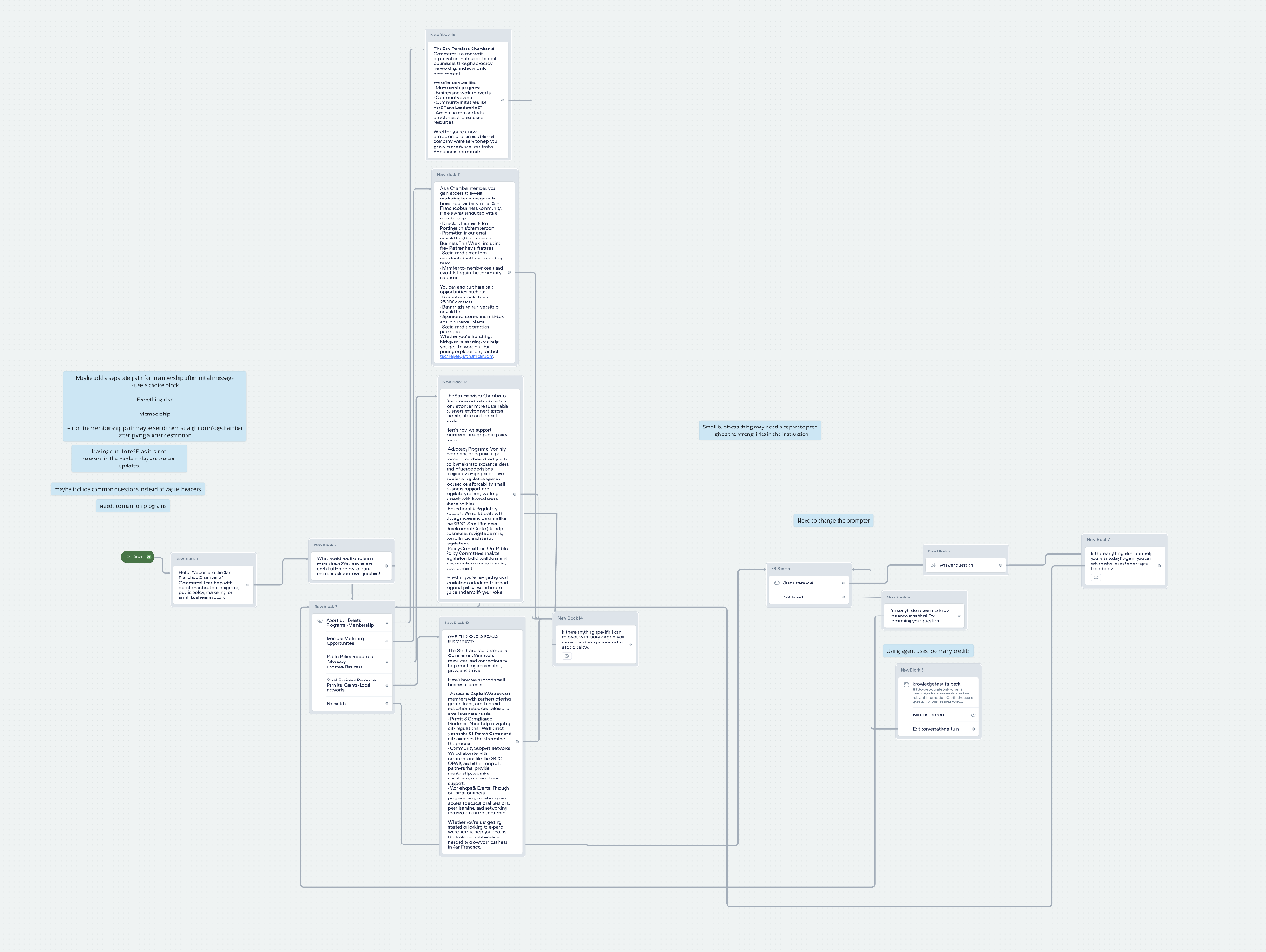
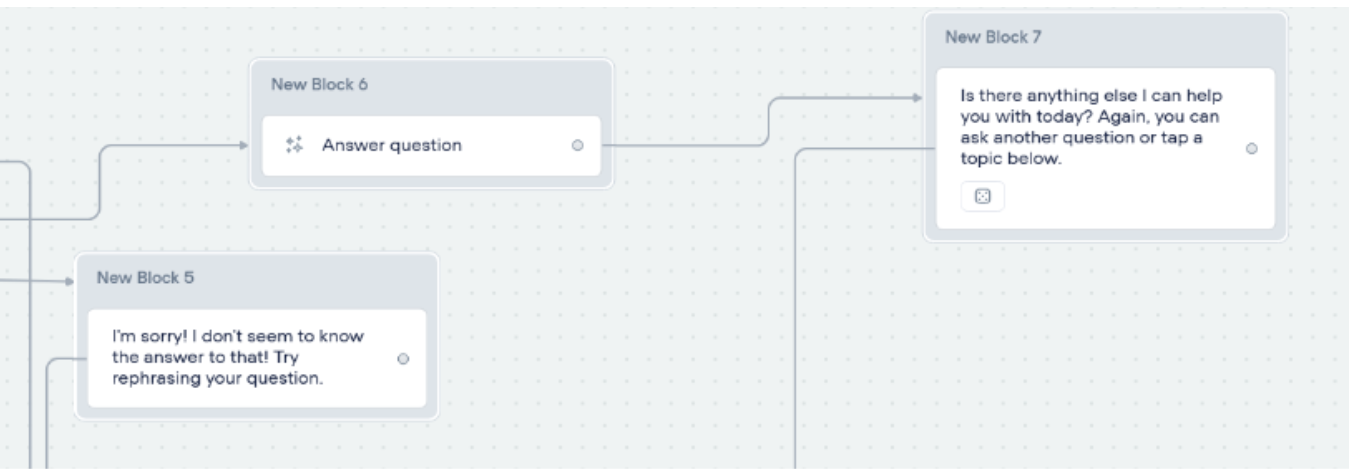
Overarching workflow: full bot architecture from entry to resolution.
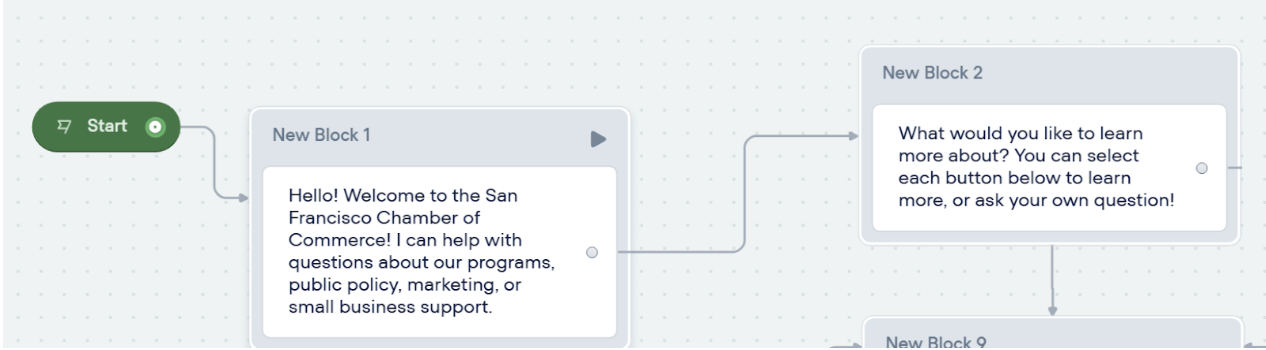
Intro block: User enters the conversation and sees the welcome message.
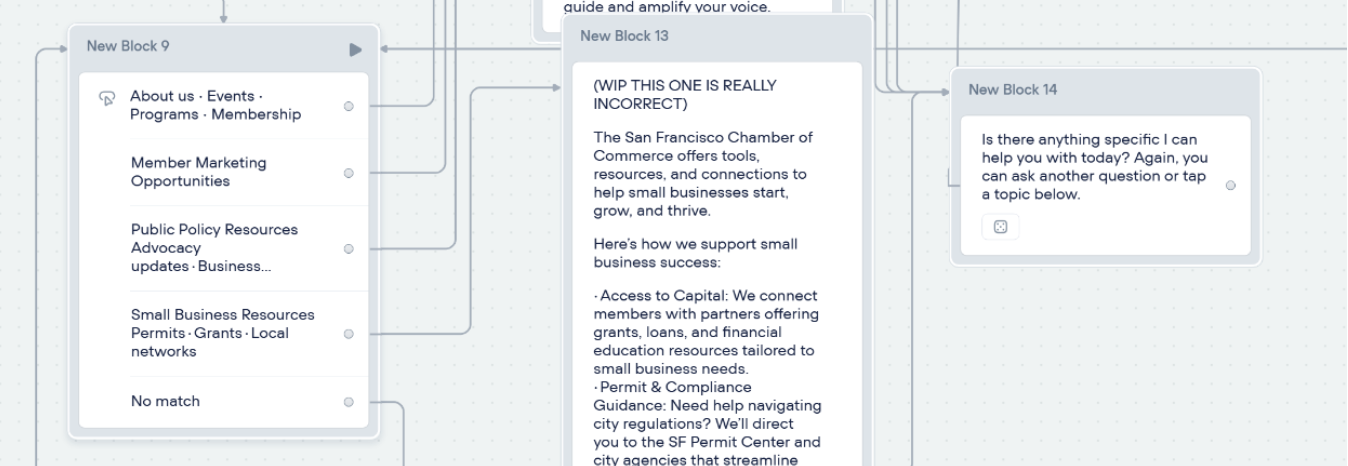
Category selection: Member chooses a topic area to route their question. Branch tracks if they ask something else.
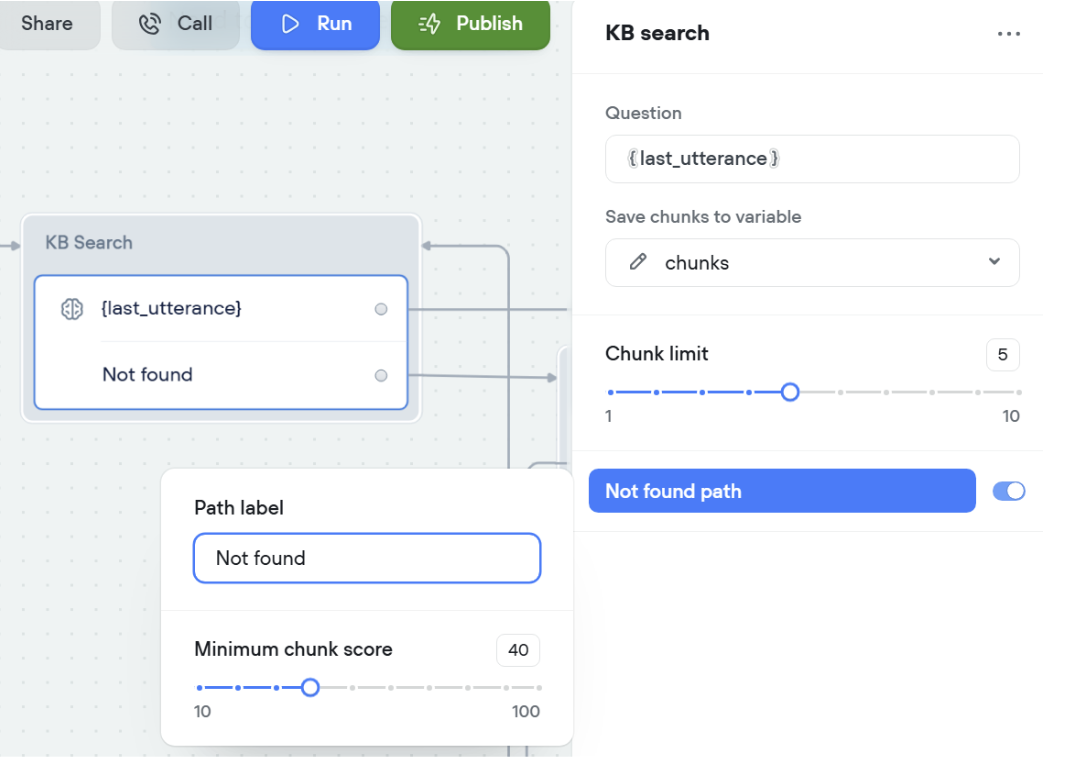
Knowledge base search triggered by semantic similarity matching, based on question.
LLM generates an answer from retrieved knowledge base chunks.
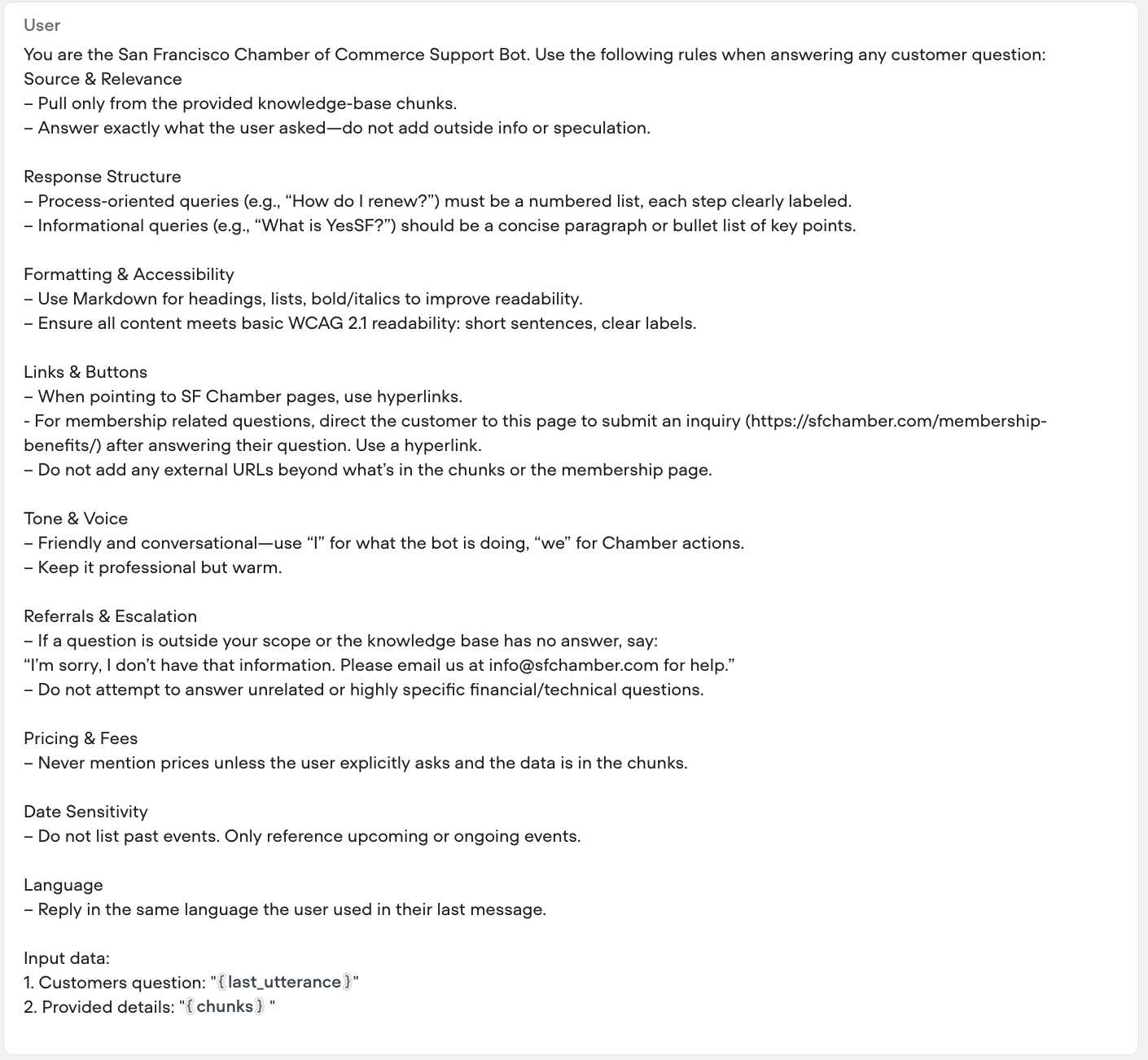
Agent prompt: System instruction and guardrails governing bot behavior. Red team tested.
01 / 06

Overarching workflow: full bot architecture from entry to resolution.

Overarching workflow: full bot architecture from entry to resolution.

Overarching workflow: full bot architecture from entry to resolution.

Overarching workflow: full bot architecture from entry to resolution.

01 / 06

Support Coverage

4 recurring member-service domains in one bot flow

Projected Inquiry Deflection

20–30% fewer repetitive inbound questions

Projected Membership Lift

5–10% increase in membership conversion

POST-PROJECT REFLECTION

What I Took Away

What I learned. Ranges anywhere from technical skills, to general lessons.

My goal is to always learn from an experience, no matter how big or small.

The project brief I was originally handed was general: create a general purpose tool centered around AI for members. Due to this, my first pass was too broad: basically an AI assistant that could answer anything about SF business.

To narrow it down, I had to first ask myself: what's the purpose of this project? After answering that, I had to interview department heads to understand what questions members actually asked. That process took longer than I expected. However, it also produced better results than any of my initial ideas would have.

I evaluated 15 platforms before landing on Voiceflow. Open-source options (Rasa, Botpress) were free but required Python I didn't have and server infrastructure the Chamber didn't have. No-code platforms had credit limits — and on Voiceflow's free plan, every single message costs a credit, AI or prewritten. That made every design decision (how many intro messages, how the loop worked) a cost decision. I wouldn't have thought that carefully about flow architecture if budget hadn't forced me to.

This was my first true internship, where I was employed and working in a functioning company. As a student, you're responsible for and allowed to make decisions end-to-end. However, in my first couple weeks, I had to learn to acknowledge organizational constraints. Outdated processes, layers of approval, etc. I learned to be wary of what I can control and what I can't, and to work with the constraints I was given.

POST-PROJECT REFLECTION

What I'd Do Differently

Redos of project parts I was unsatisfied with, or simply things I would've done differently.

Redo 01

Nowadays, this project wouldn't be all that impressive given how much AI coding has improved in just the last year alone. If I were given this project again with the tools I have now and the knowledge I have now I'd scrap Voiceflow entirely.

In a handoff memo I made, I listed a third option alongside Voiceflow and Botpress: build and host the chatbot yourself with Python and LLM API calls. I ruled it out because it was "best suited for someone with CS experience." That was true in Spring 2025. It isn't true now. AI-assisted development tools have closed the gap between what I can imagine and what I can actually build.

Redo 02

The custom solution I couldn't take then is the obvious choice today — direct LLM API calls (Claude, GPT-4o, Gemini), a proper vector database (Pinecone, Supabase, Chroma) with separate namespaces per category, metadata filtering on queries. Handfuls of other issues I ran into with Voiceflow would be nonexistent now. And instead of 100 platform credits burning through in a few test conversations, LLM API calls for this kind of Q&A cost fractions of the original cost.

Redo 03

The bigger change is what the bot could actually do. Every feature I hadn't added: capturing membership leads, routing inquiries to the right person, integrating with Salesforce — those are agentic workflows now. The passive FAQ tool becomes something that can take actions. That was imaginable then. Instead, it's buildable now.